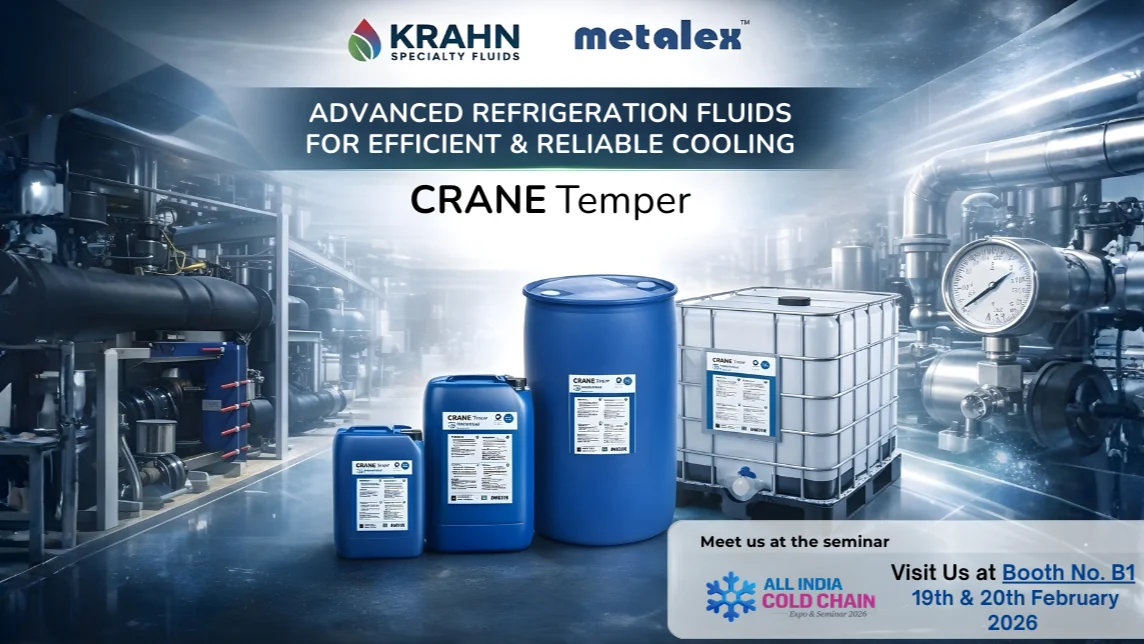
Industrial refrigeration performance is shaped by more than the compressor and evaporator. In an indirect system, the secondary heat transfer fluid circulates throughout the distribution loop, carrying cooling capacity between the primary refrigeration plant and the process or storage areas. Its viscosity, specific heat, thermal conductivity, stability and corrosion behaviour directly affect how hard the pumps work and how efficiently heat moves through the system.
Why the secondary fluid deserves engineering attention
A secondary refrigeration system separates the primary refrigerant circuit from the cooled areas. Ammonia or another primary refrigerant can remain concentrated within the machinery room while a heat transfer fluid circulates through cold rooms, process equipment, air coolers or production zones. This arrangement can support flexible distribution, simpler future extensions and reduced primary refrigerant circulation through occupied spaces.
The benefit, however, depends heavily on the fluid selected. A fluid that becomes highly viscous at low temperature increases pressure drop and pump demand. Weak heat-transfer properties may require greater flow, larger pipework or more heat-exchanger surface to achieve the same duty. Fluid selection therefore belongs in the system design stage, not as a purchasing decision made after the piping layout has already been fixed.
Where conventional glycol systems can lose efficiency
Propylene glycol and other glycol mixtures are widely used because they are familiar and readily available. Their operating behaviour changes significantly as fluid temperature falls. Higher viscosity can increase resistance through pipes, valves and heat exchangers, particularly in low-temperature applications where pumping power becomes an important part of the total energy balance.
- Increasing viscosity can raise pressure drop at lower temperatures.
- Higher pumping demand can increase operating cost.
- Reduced heat-transfer performance can influence equipment and pipe sizing.
- Fluid ageing or incorrect concentration can affect long-term system behaviour.
- Design margins may be lost when calculations use room-temperature properties.
What makes CRANE Temper different
CRANE Temper is a ready-mixed, organic salt-based heat transfer fluid developed for industrial and food refrigeration. The product range uses potassium acetate-based formulations together with a corrosion inhibitor package intended to support reliable operation across demanding temperature conditions.
The range is available in multiple versions covering freezing protection requirements from approximately −10°C to −60°C. Its low viscosity, strong thermal conductivity and useful specific heat capacity are intended to improve circulation and heat transfer compared with conventional glycol solutions, particularly as operating temperature falls.
Key characteristics
- Low viscosity across demanding refrigeration temperatures.
- High thermal conductivity and effective heat-transfer performance.
- Ready-mixed formulation for controlled product concentration.
- Long-term chemical stability under suitable system conditions.
- Advanced corrosion inhibitor technology.
- Non-toxic, non-flammable and readily biodegradable formulation.
- Suitability for food-related industrial refrigeration applications.
How fluid properties affect energy performance
Lower viscosity reduces the effort required to move fluid through a correctly designed circuit. Better thermal properties can also reduce the flow or temperature difference required for a given cooling duty. The combined effect may allow smaller pumps, lower pump input, more favourable evaporating conditions or reduced heat-exchanger duty compared with a less efficient fluid.
Published comparison figures associated with CRANE Temper have reported potential reductions of up to 55% in pump energy, up to 8% in compressor energy and up to 10% in total system energy under the stated comparison conditions. These figures should not be treated as universal guarantees. Actual savings depend on fluid temperature, pipe sizing, flow rate, pressure drop, heat-exchanger design, control strategy, operating hours and the condition of the existing system.
“The secondary fluid is part of the refrigeration system’s energy architecture. Its properties influence every metre of pipe, every pump and every heat exchanger in the loop.”Metalex Engineering Note
CRANE Temper must still be engineered as a system
A high-performance fluid cannot correct poor hydraulic design. Pipe diameter, pump selection, balancing, expansion volume, air removal, filtration, insulation and heat-exchanger approach temperature must be calculated around the selected CRANE Temper grade and its properties at the actual operating temperature.
Material compatibility and corrosion protection also require disciplined commissioning. The system should be clean before filling, mixed fluids should be avoided unless specifically approved, and water quality must not dilute or contaminate the ready-mixed formulation. Expansion vessels, seals, gaskets and pumps should be checked for compatibility with the chosen fluid and temperature range.
Where CRANE Temper can be applied
CRANE Temper can be used wherever a liquid heat transfer fluid is required in a stationary or mobile indirect cooling system. The product is particularly relevant where low-temperature performance, food-environment suitability, pumping efficiency or environmental characteristics are important.
- Cold storage and frozen warehouses.
- Food processing and packaging facilities.
- Dairy, beverage, brewery and distribution applications.
- Pharmaceutical manufacturing and temperature-controlled storage.
- Process cooling and industrial production equipment.
- Climate test chambers and low-temperature testing facilities.
- Secondary circuits paired with ammonia or other natural refrigerants.
- Warm-brine defrost systems where the design is technically suitable.
Experience from operating facilities
CRANE Temper has been used in large food-production and logistics facilities where stable temperature control, low pumping demand and long-term fluid performance are critical. Referenced installations include an indirect ammonia system at a major Swedish food-processing facility using CRANE Temper −30, and a 14,000 m² refrigerated logistics centre using CRANE Temper −15.
These applications demonstrate the role of secondary cooling in keeping the primary refrigerant concentrated within a controlled plant area while distributing cooling capacity through a flexible liquid circuit. They also show why the fluid, pump station, heat exchanger and control system must be evaluated together.
Fluid condition and system maintenance
Long-term stability does not remove the need for inspection. A planned fluid-management programme should include checks of appearance, inhibitor condition, contamination, concentration, pH where applicable and evidence of corrosion or leakage. System records should show the installed fluid grade, total volume, commissioning date and any additions made during operation.
Annual fluid condition testing is a useful part of preventive maintenance. It helps confirm that the inhibitor package remains suitable and can identify water ingress, cross-contamination or abnormal system conditions before they lead to reduced performance or equipment damage.
How Metalex supports CRANE Temper applications in India
Metalex Cryogenics supports industrial refrigeration projects with system engineering, equipment selection and integration experience across cold storage, food processing, ice plants and process cooling. For CRANE Temper applications, the engineering process begins with the required supply and return temperatures, cooling load, operating hours, pipe length, elevation, heat-exchanger duty and the characteristics of the primary refrigeration system.
This information is used to evaluate the suitable fluid grade, circulation rate, pump duty, pipe sizing, pressure drop, expansion volume and control strategy. Where the secondary circuit is paired with an ammonia refrigeration plant, Metalex can coordinate the complete interface between the compressor system, vessels, heat exchanger, pumps, controls and end-use cooling equipment.
A better fluid choice starts with correct calculations
CRANE Temper offers a technically strong alternative for indirect industrial refrigeration, especially where low-temperature viscosity, pumping demand, food-environment suitability and long-term fluid stability influence project economics. The real value is realised when its properties are incorporated into the hydraulic and thermal design from the beginning.
For a new plant or conversion project, compare fluids using operating-temperature data rather than room-temperature values. Calculate the complete system pressure drop, pump power, heat-transfer requirement and expected operating hours. That approach makes it possible to judge lifecycle cost instead of selecting a fluid only by its initial purchase price.