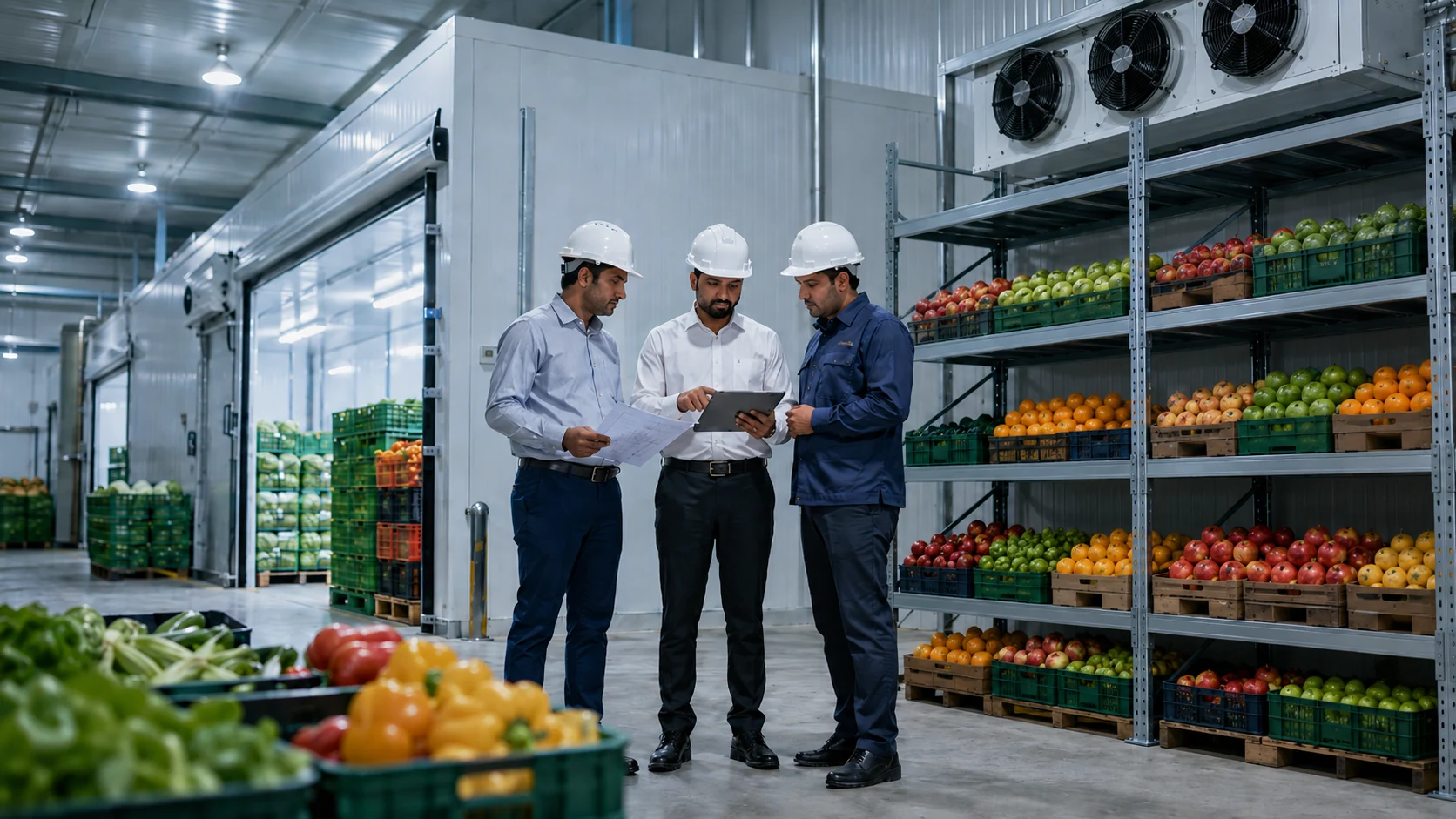
Perishable food loses value the moment it leaves controlled conditions. Fruits, vegetables, dairy, meat and seafood all continue to change biologically after harvest or processing, and every hour spent outside the right temperature band chips away at shelf life, weight and market price. For processors, distributors and agri-business investors, this makes cold storage infrastructure less of a real estate decision and more of an engineering one. A facility that is undersized on refrigeration load, poorly insulated, or fitted with the wrong compressor configuration will underperform for the life of the asset, regardless of how well the building itself is constructed.
Why cold storage capacity remains a pressing need
India's post-harvest supply chain has long struggled with a mismatch between production volumes and available cold chain infrastructure, and a large share of existing capacity is concentrated in single-commodity storage such as potatoes. This leaves fruits, vegetables, dairy, meat, seafood and pharmaceutical products competing for a comparatively small pool of multi-purpose, temperature-controlled space. As consumption patterns shift toward fresh and minimally processed food, demand for properly engineered storage capacity continues to outpace supply in many regions.
This is also why most people researching a new facility are looking at two questions at once: the engineering, and the investment case. Project cost varies enormously with capacity, location and technology, and schemes such as NABARD's cold chain subsidy or the Ministry of Food Processing Industries' PMKSY grant can materially change the financial picture. That side of the decision sits with your finance and subsidy advisors; the point here is simply that it should run in parallel with the engineering work, not after it, since the two shape each other. Retrofitting an underperforming plant later is far more expensive than designing it correctly at the outset.
What a facility actually involves
A cold storage plant is often pictured as an insulated shed with a compressor bolted to the outside wall, but the reality is a coordinated system of thermal, mechanical and control engineering. The building envelope, refrigeration machinery, air distribution, humidity management and automation all have to work together to hold a consistent temperature under real-world conditions, including door openings, product loading, respiration heat from fresh produce and seasonal ambient variation. For fruits and vegetables in particular, temperature control alone is not sufficient, since produce continues to respire after harvest, releasing heat and moisture that the system has to account for.

How the refrigeration system works
At the core of any industrial cold storage plant is a vapor-compression refrigeration cycle. A compressor draws in low-pressure refrigerant gas and compresses it, raising its pressure and temperature. This hot, high-pressure gas is routed to a condenser, where it rejects heat to ambient air or water and condenses into a liquid. The liquid refrigerant passes through an expansion device, dropping in pressure and temperature before entering the evaporator coils inside the cold room, where it absorbs heat from the stored product and evaporates back into a gas. Ammonia (NH3) remains widely used in industrial-scale applications for its high energy efficiency. Depending on the required room temperature, the system may be single-stage for moderate loads or two-stage for lower-temperature applications.
Core equipment in the plant
Ammonia piston compressors, available in water-cooled and air-cooled configurations, form the mechanical heart of the plant and are sized according to the calculated refrigeration load. Evaporative condensers reject heat efficiently by combining air flow with water evaporation, which is generally more effective at industrial scale than purely air-cooled condensing. Pressure vessels manage refrigerant charge and protect compressor lubrication, control panels govern compressor staging and defrost cycles, and refrigeration valves and purgers maintain system integrity by managing refrigerant flow and removing non-condensable gases.
Design considerations before building
The single most important planning step is an accurate heat load calculation, accounting for transmission gain, infiltration through doors, respiration heat, and the heat removed to bring incoming product down to set-point. Undersizing this calculation leaves the system unable to recover temperature quickly after door openings or high-volume loading. Insulated panel thickness, floor construction to prevent frost heave, door and dock design, and racking layout for proper air circulation all influence how the theoretical design translates into real performance.
Operating efficiency and long-term performance
Refrigeration is typically the largest ongoing operating cost in a cold storage facility, which makes efficiency a design priority rather than an afterthought. Correctly staged compressors that match output to actual load, appropriate two-stage compression where relevant, efficient evaporative condensing, and demand-based defrost automation all reduce unnecessary energy consumption. None of these gains are automatic; they depend on the system being engineered and commissioned correctly, then operated with disciplined maintenance.
"The compressor is only as efficient as the system engineered around it. Undersized insulation or a poorly calculated heat load will erode the performance of even the best refrigeration equipment."Metalex Engineering Team
Safety and reliability in ammonia systems
Ammonia is efficient and well-proven, but it requires system design and operating discipline appropriate to a toxic, pungent gas. Properly rated pressure vessels, safety relief valves, leak detection, adequate ventilation and clear emergency procedures are standard requirements, not optional additions. Purgers remove non-condensable gases that reduce condenser efficiency over time, and a compressor or vessel running consistently at the edge of its rated capacity shows accelerated wear and a higher likelihood of unplanned downtime.

Common mistakes in planning
- Underestimating the refrigeration load using generic assumptions instead of a facility-specific calculation.
- Choosing compressor capacity on budget alone, without matching it to actual duty cycles.
- Overlooking maintenance access when laying out compressor rooms and piping.
- Treating controls and automation as a low-priority line item.
- Failing to plan for future expansion, forcing costly retrofits within a few years.
Selecting the right system
There is no single correct configuration for every project; the right answer depends on the product, required temperature range, throughput, ambient site conditions and available utilities such as water for evaporative condensing. Deep-freeze operations for meat or seafood usually call for two-stage compression, while water-cooled systems can offer efficiency advantages where a reliable water supply is available. Early technical consultation, before civil construction begins, tends to produce better long-term outcomes.
How Metalex Cryogenics supports these projects
Metalex Cryogenics works with industrial refrigeration projects from the engineering stage, starting with the product to be stored, required temperature and humidity conditions, throughput expectations and site constraints. Compressor selection, whether single-stage or two-stage, water-cooled or air-cooled, is matched to the calculated duty. The product range, including MX Series water-cooled and ISH Series air-cooled ammonia piston compressors, evaporative condensers, pressure vessels, refrigeration valves and purgers, allows the system to be specified as an integrated package. For projects requiring full execution, Metalex supports turnkey delivery covering engineering, equipment supply, installation and commissioning, with ongoing spare parts and maintenance support after handover.

What to evaluate before you build
A cold storage facility is a long-term industrial asset, and its performance is set largely by decisions made before construction begins: an accurate heat load calculation, correctly matched compressor configuration, adequate insulation and door design, dependable heat rejection, and controls that actually reduce energy use. Businesses evaluating a new facility are better served by starting with the refrigeration engineering rather than treating it as equipment to be fitted into a finished building.